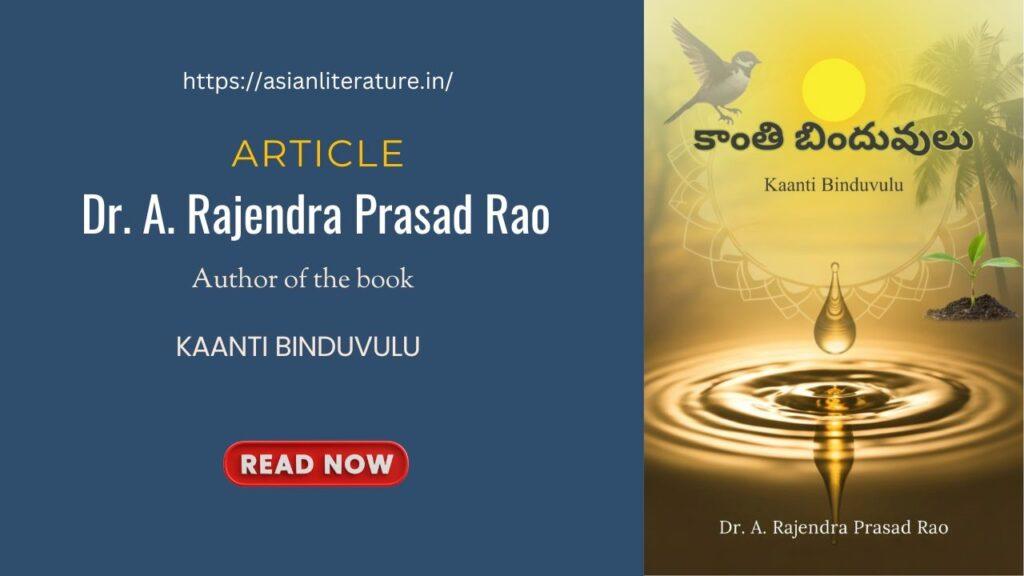
A book that turns reflection into transformation.
Drops of Light: Illuminating the Path to a Disciplined and Purposeful Life (A Featured Article)
In a world defined by the speed of change and the constant barrage of digital noise, wisdom often arrives not as a thunderclap but as a quiet whisper. This profound truth is at the heart of “Drops of Light” (కాంతి బిందువులు), a new and insightful collection of twenty-seven essays by the acclaimed educator and writer, Dr. A. Rajendra Prasad Rao Ambeer. This featured article explores the philosophy of the book, which the author describes as an earnest attempt to offer thoughts on life, faith, and inner strength, one practical insight at a time.
The Genesis of Timeless Wisdom
Dr. Ambeer, a recipient of the Best Teacher Award of Telangana State (2018) and the MVLA Global Best Educator Role Model Award (2025) , began writing these reflections not with a formal plan, but organically—as simple, yet profound, notes for his students, colleagues, and friends over many years. They emerged from the universal, persistent questions that refuse to leave us: “How should we live wisely?” “What constitutes true education?” and “How can we confront loss, conflict, and change without losing our moral center?”.
The book is an answer to these questions—a collection of reflections meticulously crafted to be practical, clear, and firmly rooted in the values that have shaped the author’s own life: the civilizing power of Sanatana Dharma, the dignity of a disciplined life, the joy of learning, and the courage to serve. While the themes are eternal, their contexts are immediately familiar—our homes, schools, temples, offices, and even our WhatsApp groups. The author’s aspiration is simple: if these pages feel close to the reader’s daily life, they will have accomplished their purpose.
Part I: Lessons from the Silent Gurus of Nature
The first set of essays invites us to re-examine the world and discover the “gurus we have ignored”. These chapters draw profound lessons from the ordinary wonders of the world, demonstrating how humility, perseverance, and the right perspective can shine brighter than fanfare and noise.
The Sun and the Bee: A Dual Masterclass in Duty and Timely Action
The opening chapter, “The Sun and the Bee” , presents the sun and the bee as two unique masters—the sun, a symbol of steadfastness and selfless service, and the bee, an envoy of timely action and awareness.
The Sun, the ‘Eternal Guru of Duty and Detachment’ , rises and imparts its golden light equally upon peaks and valleys alike, showing no discrimination. It gives light and warmth unconditionally. From the sun, we learn three eternal lessons:
- Be Stable in All Seasons of Life: The sun is unaffected by the world’s perception, remaining constant even as people applaud its rise and ignore its set. Our true value is not dependent on others’ applause but on the consistency of our own inner light. Joy and sorrow are inseparable, like the twin wings of time; wisdom lies in walking with balance through both.
- Use Time Wisely: Every sunrise reduces the sun’s journey by a day, and similarly, our life clock moves a step closer to its final sunset each morning. This truth should bring not despair, but awareness. Time, when respected, becomes our greatest ally. The sun never wastes a second, constantly moving and performing its duty. The lesson is that life is measured not by its length but by how purposefully we spend each moment.
- Perform Your Duty Without Expecting the Result: The sun shines even on lonely oceans and deserts where no human offers a thank you. This reflects the sacred teaching of the Bhagavad Gita: “Perform your duty without attachment to the results; for action without desire leads to peace”. Our satisfaction must be found in the work itself, not the recognition.
In contrast, the tiny Bee, which represents the moral of Timely Action , holds great wisdom for procrastinators. The accompanying parable tells of a bee so absorbed in the nectar of a beautiful lotus that it forgot the passage of time. When the sun disappeared, the lotus began to close its petals, trapping the bee within. The story serves as a stark reminder that in the pursuit of pleasure and abundance, we must not forget the sacredness of time and our ultimate duty.
Other essays in this section, such as “The Coconut Tree and the Date Palm” and “The Little Finger’s Secret” , further emphasize the virtues of transformation, resilience, and selfless service. The Date Palm survives the harshest heat to yield its fruit, while the Coconut Tree, though watered with the same rain, transforms it into sweet nectar. They teach us that our values are the roots that sustain us, and the sweetness we produce is the legacy we leave behind.
The touching narrative of “The Sparrow’s Lesson” , where a humble cowherd boy taught an influential dignitary about compassion by refusing to disturb a sparrow’s nest, reminds us that compassion is often taught by those whom society overlooks. It is a lesson that knowledge is not the sole domain of the educated, but the treasure of the aware heart.
Part II: The Quiet Strength of Inner Discipline
The second cluster of essays focuses on the inner life—the intentions, habits, and quiet discipline that ultimately shape our character. Chapters here urge us to choose depth over outward show.
The Power of Inner Discipline (Antara Niyama Shakti)
Dr. Ambeer argues that while external discipline (enforced by parents, teachers, and rules) establishes order, it is ultimately temporary. True transformation comes from Antara Niyama Shakti (The Power of Inner Discipline). This inner strength allows an individual to do the right thing even when no one is watching. The essays, including “The Tests of Gurus” , show that tests are not punishments, but purifiers , meant to refine the student’s resolve, humility, and focus, as illustrated by the stories of Arjuna and Dronacharya , and Hanuman and Surya.
The book elevates fundamental life skills into spiritual disciplines:
- The Power of the Word (Maatala Shakti): A chapter is dedicated to the idea that words possess the power to either wound or heal lives. The words we speak become the atmosphere (aura) we carry and spread.
- Ikigai: The Art of Living with Purpose: This reflection explores the Japanese concept of finding a reason for being, emphasizing pace and purpose—the art of walking steadily rather than hastily, and making every day meaningful.
- Illumination, Not Accumulation: The author critiques the modern obsession with gathering degrees, titles, and possessions while neglecting the inner light of the soul. The true journey of life is from knowledge (Jnana) to Illumination (Jnanodayam).
Part III: Education, Ethics, and the Eternal Path
The final set of reflections addresses the crucial spheres of education, ethics, and public life, all subjects dear to the author.
The True Purpose of Education and Societal Ethics
Essays like “The Crown of Intellect” and “The Tree of Education” chart the journey of a learner who connects knowledge with responsibility and service. “Schools, Once Havens of Wisdom and Light” is a plea to restore honor, security, and true values to academic campuses.
A practical call for cultural change is made in “The Power of Discussion Over Arguments”. The author posits that argument is often driven by the ego’s need to prove the other person wrong, while discussion is driven by the desire for mutual benefit and shared learning. The simple, actionable advice is to listen more, assume less, and seek the common good.
Timeless Spiritual Reflections
The book seamlessly integrates spiritual reflections with daily life. The chapter on “Sanatana Dharma: The Eternal Way of Life” presents a life path that harmonizes duty (Dharma), devotion (Bhakti), and discipline without fundamentalism.
Perhaps the most potent spiritual lesson is found in “The Three Divine Commands”, which revives the ancient Upanishadic teaching of the single syllable ‘Da’ for humanity’s needs:
- Daman (Self-Control): Needed by the ‘Devas’ (the intelligent, ambitious part of us).
- Daan (Charity): Needed by the ‘Manavas’ (the social, material part of us).
- Daya (Compassion): Needed by the ‘Rakshasas’ (the cruel, egotistical part of us).
This single letter offers a complete solution to the modern age, which is characterized by excess without control, wealth without generosity, and authority without compassion.
The Thread of Light
The concluding thought of “Drops of Light” is that a single thread runs through all its diverse topics: Wisdom is not a theory; it is a way. It is reflected in every action—the way we speak to a child, cross the road, spend money, end an argument, pray, and forgive. The book does not demand agreement, but only asks the reader to pause, reflect, and carry at least one practical insight into their next decision or conversation. Read sequentially or randomly, the twenty-seven chapters together form a “small lamp”. If this collection inspires a young student to choose discipline over distraction, a parent to choose listening over lecturing, or a reader to choose light over noise, then, Dr. Ambeer concludes, the pages will have fulfilled their purpose.