Choose light over noise. Let awareness guide your journey.
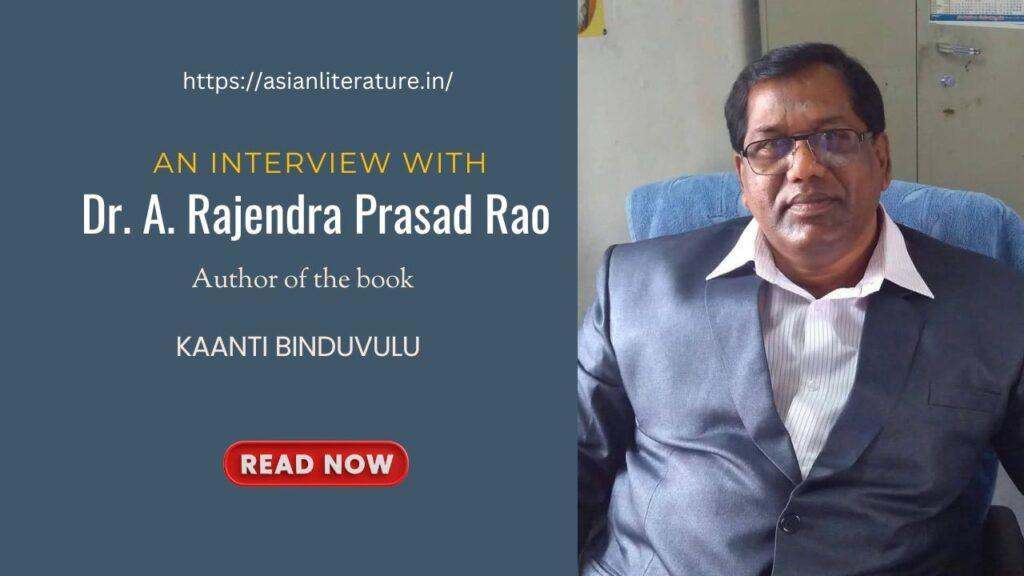
About the author: Rajendra Prasad Rao Ambir is a distinguished educator, writer, and thinker whose life has been dedicated to nurturing minds and values through the power of education. With over three decades of service as a teacher, principal, and mentor, he is widely respected for his integrity, compassion, and commitment to holistic learning.
He is the author of four acclaimed books — Echoes of the Heart, My Footprints, Stories and Skits, and Resilience (A Teacher’s Journey) — each reflecting his deep connection with life, literature, and the human spirit. His writings blend simplicity with depth, drawing wisdom from both ancient Indian philosophy and contemporary experience.
In recognition of his outstanding contribution to the field of education, he was honored with the Best Teacher Award of Telangana State (2018) and the MVLA Global Best Educator Role Model Award (2025).
Born in Chityal village of Kamareddy district in Telangana, Rajendra Prasad Rao grew up in a family rooted in tradition, discipline, and service. Inspired by his teachers and guided by life’s challenges, he developed a profound belief in the transformative power of learning and character.
Beyond the classroom, he has served for over two decades as a Resource Person and Education Coordinator with Saraswati Vidya Peetham (Vidya Bharati), contributing to educational research and teacher training across the state.
His latest work, Drops of Light, brings together twenty-seven reflections that blend moral insight, spiritual clarity, and educational wisdom. Through these writings, he continues his lifelong mission — to impart knowledge, inspire, and remind us that true education is not merely the acquisition of information, but the illumination of the soul.
“A teacher by profession, a writer by passion, and a seeker by nature — Rajendra Prasad Rao Ambir continues to touch lives through his words and deeds.”
Question – The book’s premise states that it was born from your search for answers to fundamental questions: “How should we live wisely?” and “What is true education?”. If you had to offer today’s youth a single, most crucial “Drop of Light” as the answer to these two questions, what would it be?
Answer – Awareness. If a young person learns to live with awareness—of their thoughts, actions, environment, and purpose—life itself becomes the teacher. Awareness transforms experience into wisdom and knowledge into character.
Question – Your essays are rooted in the timeless values of Sanatana Dharma. In a contemporary, fast-paced, and diverse world, how do you ensure that these ancient principles remain practical and relatable, rather than being perceived as merely theoretical or cultural concepts?
Answer – Sanatana Dharma is a timeless science of harmonious living. I express its principles through universal human values like truthfulness, balance, compassion, and gratitude, making them practical through daily habits.
Question – The first chapter, “The Sun and the Bee,” emphasizes the lesson of doing your ‘duty without expecting the result’. As an educator in a highly competitive society, how do you reconcile this philosophy with the intense, results-oriented pressures faced by students, parents, and schools today?
Answer – The teaching does not deny results; it asks us not to be enslaved by them. Focusing on effort, mastery, and calmness frees students from anxiety and improves performance.
Question – You differentiate between ‘external rule’ and ‘inner discipline’ (Antara Niyama Shakti). What is the most practical first step a person can take, in their daily routine, to consciously cultivate this ‘inner discipline’ that builds true character?
Answer – Begin with one small promise each morning—and keep it. This builds Antara Niyama Shakti through quiet inner victories.
Question – Your chapter on “The Power of the Word” highlights its ability to heal. Can you share a personal observation from your decades as a teacher where the power of a single, well-chosen word or quiet gesture transformed a challenging situation or changed a student’s life trajectory?
Answer – Telling a withdrawn student ‘I see potential in you’ transformed her life. A sincere word can unlock a destiny.
Question – You bridge spiritual wisdom with contemporary life in essays like “Swords to Software” and “Aura Science”. How do you believe the unseen, quiet influence of our habits and thoughts (our ‘aura’) interacts with the hyper-visible, technologically driven world we inhabit?
Answer – Technology amplifies our inner state. A disturbed mind spreads noise; a calm mind spreads light. Inner purity shapes how we use modern tools.
Question – “The Three Divine Commands” offers a complete ethical framework through the single syllable ‘Da’ (Daman, Daan, Daya). Which of these three qualities—Self-Control, Charity, or Compassion—do you feel is most critically absent in contemporary public discourse and social media interactions?
Answer – Self-control (Daman) is most lacking today.
Question – You make a compelling case for “The Power of Discussion Over Arguments”. What is the ultimate ‘common benefit’ you urge readers to seek in a discussion, and what is the key technique for shifting a polarized conversation from an ego-driven argument to a purpose-driven, cooperative dialogue?
Answer – Seek shared understanding, not victory. Listening to understand—not respond—turns arguments into meaningful dialogue.
Question – The title “Drops of Light” suggests that knowledge comes in ‘silent moments’ rather than a ‘thunderclap’. Can you recall the most profound “silent moment” in your life that served as an unexpected ‘drop of light’ that ultimately defined the direction of your writing and teaching?
Answer – A student once asked why I teach with passion. Later, in silence, I realized: ‘Teaching is my worship.’ This moment shaped my life.
Question – Finally, you write that you hope your book helps a reader choose ‘light over noise’. From your perspective, what is the loudest ‘noise’ of our current age—the one that distracts us most from discovering our inner light—and how does your collection provide a map to navigate away from it?
Answer – The loudest noise is constant comparison. ‘Drops of Light’ guides readers toward inner clarity, purpose, and peace.