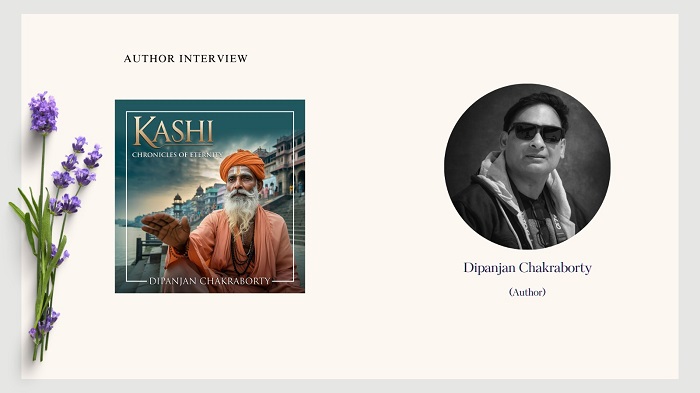
QUESTIONNAIRE – For Author Dipanjan Chakraborty By Asian Literature
Asian Literature : Author Dipanjan Chakraborty, do you believe a city like Kashi changes the photographer—or does the photographer change the way he sees Kashi?
Author Dipanjan Chakraborty : I believe it depends on who you are, and why you go to Kashi in the first place. If one arrives merely as a tourist, camera in hand, checklist mentality intact, Kashi may impress, overwhelm, or even disappoint, but it rarely transforms. In such a case, neither does the city change the person, nor does the person meaningfully change the way Kashi is seen.
But if you go as a seeker – someone who has read, reflected, and imaginatively inhabited Kashi long before the first visit – the city leaves a deep and lasting imprint. It works quietly, almost invisibly, reshaping your inner tempo.
In my own journey, it has been a dialogue of both. Kashi has changed me profoundly as a photographer. It has made me calmer, more patient, more selective in image-making, and far more conscious of why I chose to pick up the camera in the first place. At the same time, my perception of Kashi has evolved over the years. I now look for quietude, for small, seemingly insignificant moments that carry an eternal quality. These fragments of time, subtle and unassuming, leave the deepest imprint on me. Not the over-the-top curated events that attract lakhs of people jostling for space on the ghats.
Asian Literature : How do you see the balance between documentation and interpretation in your work?
Author Dipanjan Chakraborty : I do not see myself as a documentary photographer. While documentary photography holds an essential and irreplaceable place in the medium, my own inclination is far more emotive. For me, documentary work is largely descriptive – it records and explains – but it leaves relatively little room for interpretation.
My approach is to deliberately leave things unsaid. I am drawn to ambiguity, to suggestion rather than explanation. I want the viewer to meet the image halfway, to bring their own instincts, emotional state, memories, and sensibilities into the act of seeing. In that space between what is shown and what is withheld, interpretation begins.
It is there, I believe, that the scope of visual art actually expands, when an image is not finished by the photographer, but completed by the viewer.
Asian Literature : Was there a turning point when you felt the book’s vision finally came together?
Author Dipanjan Chakraborty : Yes – my visit to the Akharas last year proved to be a quiet but decisive turning point. I had been there many times before, but this time the engagement was deeper. I spent extended periods observing, interacting, and photographing, and for the first time, I felt a sense of contentment with the images I was able to create.
That experience gave me clarity. It felt as though a crucial chapter of Kashi, one that had long remained just outside my work, had finally come within its fold. It was then that I sensed the arc of the project was complete enough to begin thinking seriously about shaping and curating the photographs into a book.
Asian Literature : What do you hope readers feel when they turn the pages of this book?
Author Dipanjan Chakraborty : I hope readers feel a sense of belonging. A quiet recognition, as if the book has been waiting for them. I hope they feel calm, a meditative stillness, as though they are turning the pages of something that carries eternity within it.
More than anything, I wish for the impact to linger after the final page has been turned. That is all I long for. Not an engagement with technicalities – the lenses used, focal lengths, ISO or aperture – but an emotional resonance that stays, unspoken yet enduring.
Asian Literature : Do you think a place like Kashi can ever be fully understood, or is mystery essential to its identity?
Author Dipanjan Chakraborty : Never. If Kashi could be fully understood, people would not have been drawn to it for centuries, nor would I have kept returning for nearly three decades. Its enduring magic lies precisely in its inexhaustibility.
Each visit reveals a dimension I had not encountered before – new stories, unheard chronicles, unfamiliar ghats, and entirely fresh realizations. What once felt familiar quietly metamorphoses itself into something new. In that sense, Kashi resists completion.
The mystery must remain. There can be no final understanding, no definitive arrival. It is this open-endedness, this refusal to be fully grasped, that forms the very essence of Kashi.
Asian Literature : If you had to describe Kashi through a single emotion, what would it be—why?
Author Dipanjan Chakraborty : Belonging. I cannot fully explain why. Kashi is neither the city I was born in nor the place where I grew up. Yet it became a part of me long before my first visit – through books, cinema, and stories shared by people close to me.
When I finally arrived, I felt an unexpected sense of home. I do not try to rationalize it. Perhaps it is something deeper than comprehension, an emotional inheritance rather than a geographical one. Where familiarity precedes memory.
Asian Literature : How did you decide which images to include and which to leave out, especially when the place is so emotionally vast?
Author Dipanjan Chakraborty : It is indeed a tricky process. At its core, it begins with instinct. I may be a photographer by practice, but I am a lover of photography first. Certain images speak to me immediately, without analysis or justification, and these instinctive responses form the first draft almost naturally.
What follows is a long process of pruning – distilling the work down to what feels indispensable. I begin to think about continuity, emotional weight, narrative flow, uniqueness, and the avoidance of repetition. Each image must earn its place, not just on its own, but in conversation with the others.
That said, it is far easier to describe than to do, especially when the subject is as emotionally vast as Kashi. Letting go of images is often the hardest part of shaping the book.
Asian Literature : Finally, what does “eternity” mean to you in the context of this book—and in your personal journey?
Author Dipanjan Chakraborty : For me, eternity in the context of this book is a sense of time travel – a continuity of human stories that flow endlessly through Kashi. My forefathers would have walked its lanes; my maternal grandmother was from Kashi. I have been drawn there, and I know that those who come after me will find their way there too, just as my readers might, in their own time.
This unbroken rhythm across generations is what I wished to capture. Time moves forward, lives change, yet in Kashi, something essential remains untouched. That sense of perpetuity – the feeling that while time passes, nothing truly alters at its core – is the lingering impact I hoped the book would leave behind.