This book teaches that peace is not to be achieved but already within you.
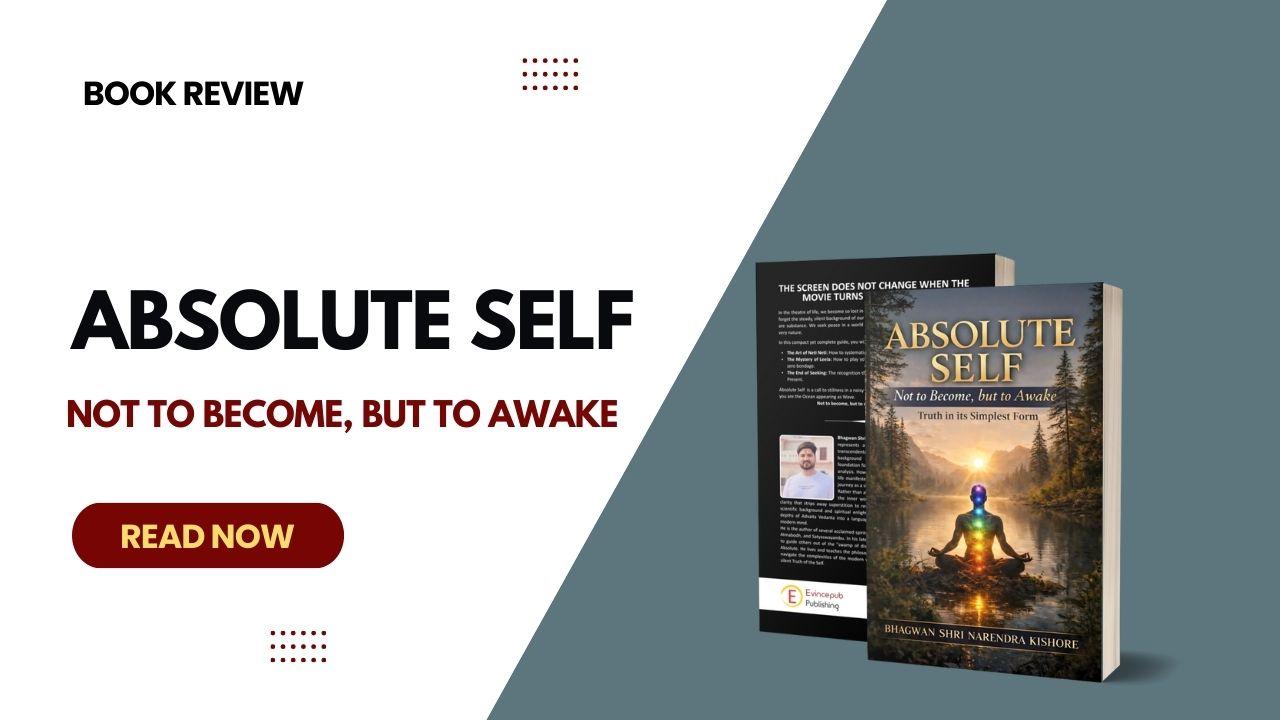
Title: Absolute Self: Not to Become, but to Awake
Author: Bhagwan Shri Narendra Kishore
ISBN: 9789373351186
Publisher: Evincepub Publishing
In a world filled with noise, speed, and endless chasing, Absolute Self: Not to Become, but to Awake arrives like a calm, steady voice reminding us of something deeply forgotten. This book is not a motivational manual, nor is it a philosophical text filled with heavy academic language. Instead, it is a spiritual companion that speaks directly to the reader in simple words, gentle stories, and powerful truths. It does not ask you to change who you are; it asks you to recognize who you already are.
At its heart, Absolute Self carries a clear message: peace, truth, and fulfillment are not to be achieved in the future—they are already present within us. We are not here to “become” something new, but to “awake” to our real nature.
A Book That Feels Like a Conversation
One of the most striking aspects of this book is its tone. The author does not write like someone delivering lectures from a high pedestal. Instead, the book feels like a sincere conversation between a guide and a seeker. Each chapter gently takes the reader deeper into self-inquiry, using everyday examples, short stories, and simple logic that makes even complex spiritual ideas easy to understand.
The language is clear, accessible, and rooted in Indian thought, yet universal in its appeal. Readers from any background—religious or non-religious, young or old—can connect with its ideas because the core questions it addresses are universal:
Who am I?
Why do I suffer?
Why is there restlessness even after achieving success?
Is true peace possible?
Rather than giving complicated techniques, the book encourages reflection. It invites the reader to look inward instead of outward.
The Central Theme: Awakening to the Self
The title itself reveals the essence of the book: Not to Become, but to Awake. Most self-help and spiritual books focus on becoming better, stronger, more successful, or more peaceful. But this book challenges that very idea. It suggests that our suffering comes from forgetting who we truly are. We identify with the body, the mind, our roles, our achievements, and our failures—and in doing so, we lose touch with our deeper Self.
Through concepts like Neti Neti (not this, not this), the author explains that we are not the body, not the thoughts, not the emotions, and not the roles we play in society. What remains when all these are observed? Pure awareness—the witness. That awareness, the book argues, is our true identity.
This idea is not presented as a belief system but as an invitation to inquiry. The author does not ask the reader to accept blindly. Instead, he repeatedly encourages observation: observe your thoughts, observe your emotions, observe the changes in your body—and notice that something within you remains unchanged. That unchanging presence is the “Absolute Self.”
Powerful Use of Stories and Analogies
A major strength of the book is its storytelling. Almost every concept is explained through a story, making it easier to grasp and remember.
The story of the king and the sage in the chapter “Who Am I?” beautifully illustrates how external identities—like titles, roles, and positions—are not our true self. The king, who proudly calls himself a king, is gently led to realize that this identity is temporary and given by society, not his real essence.
Similarly, stories like the monkey trapped by chickpeas, the emperor and the mysterious old woman, and the thief searching for the philosopher’s stone are simple yet deeply symbolic. They explain attachment, desire, ignorance, and self-realization in a way that feels natural rather than intellectual.
These stories make the book engaging. You are not just reading abstract philosophy; you are experiencing it through images and narratives that stay with you long after you finish the page.
Desire, Anxiety, and Inner Incompleteness
The chapters on stress, anxiety, and desire feel especially relevant in today’s world. The author explains that anxiety is born from attachment to outcomes. We want life to go according to our expectations, and when it doesn’t, we suffer.
The idea that desire can never truly be satisfied is explored with honesty and depth. The book clearly distinguishes between needs and endless wants, showing how the pursuit of “more” keeps us trapped in restlessness. What makes this discussion powerful is that it does not judge desire harshly; instead, it helps the reader understand its roots.
According to the author, desire arises from a sense of incompleteness. When we believe we are small, limited beings, we try to fill that emptiness with possessions, relationships, achievements, and recognition. But no matter how much we gather, the inner emptiness remains—because the problem was never outside to begin with.
This insight feels both simple and transformative. It encourages the reader to shift attention inward rather than continuously seeking fulfillment in external success.
World as Illusion, but Life as Meaningful
The chapter discussing the idea that “the world is illusion, Brahman is truth” is handled carefully and sensitively. Instead of presenting this as a reason to reject life or responsibilities, the author clarifies that illusion does not mean the world is fake—it means our misunderstanding of it is the problem.
He explains that Maya (illusion) is not destroyed by changing external situations but by changing perception. This is a mature and balanced approach. The book does not encourage escapism. It does not suggest abandoning life, family, or duties. Instead, it teaches how to live fully in the world without being bound by it.
This perspective makes the book practical rather than abstract. It shows that spirituality is not about running away from life, but about seeing life clearly.
The Courage of the Author’s Voice
One of the most unique aspects of the book appears in the chapters where the author speaks about his own name and declaration: “I am the way, the goal, and the truth.” Many readers may initially feel uncomfortable with such a statement. The author does not avoid this discomfort; instead, he addresses it directly.
He explains that this statement is not born of ego but of realization. According to his perspective, when the false ego dissolves and the Self is realized, the individual no longer experiences separation between self and the divine. In that state, saying “I am That” is not arrogance but clarity.
Whether a reader agrees fully or not, this honesty is refreshing. The author does not try to soften his voice to gain approval. Instead, he presents his truth openly and leaves the reader free to reflect. This fearless authenticity gives the book a strong character.
Simple Yet Deep Spirituality
What makes Absolute Self special is its balance between simplicity and depth. Many spiritual books either become too complex for the average reader or too shallow to be meaningful. This book manages to stay in the middle: easy to read, yet profound in its implications.
Concepts like surrender, self-inquiry, ego, awareness, liberation, and completeness are explained without heavy Sanskrit jargon or complex philosophical debates. The reader does not feel overwhelmed. Instead, they feel guided step by step.
The chapters are structured in a way that each one builds upon the previous. You can read the book slowly, reflecting after each chapter, and it still feels complete. At the same time, you can read it continuously like a flowing journey of understanding.
Emotional Impact and Inner Reflection
Beyond ideas and concepts, the real power of this book lies in the questions it awakens within the reader. While reading, you may find yourself pausing often—not because the text is difficult, but because it feels personal.
You may start noticing your own attachments, your own fears, your own restlessness. You may begin questioning the identities you carry: your profession, your achievements, your failures. The book gently pushes you toward self-observation.
This makes Absolute Self not just a book to be read, but a book to be lived with.
Who Should Read This Book?
This book will deeply resonate with:
- Readers interested in spirituality and self-awareness
- Those struggling with anxiety, dissatisfaction, or inner restlessness
- Seekers who feel that material success has not brought true fulfillment
- Readers of Indian philosophy who prefer simple, practical explanations
- Anyone asking the question: “Is there more to life than this?”
Even readers who are new to spiritual thought can approach this book without fear. Its simplicity makes it accessible, while its sincerity makes it trustworthy.
Final Thoughts
Absolute Self: Not to Become, but to Awake is not a book that promises miracles. It does not offer quick fixes or external solutions. Instead, it offers something far more valuable: a direction inward.
It reminds us that peace is not something we must earn. It is something we must recognize. It reminds us that we are not broken beings who need to be fixed, but awakened beings who need to remember.
In a time where most people are running toward “more,” this book gently invites us to stop—and look within. That invitation alone makes it meaningful. And for those who accept it sincerely, this book can become not just a read, but a turning point.
Buy on Amazon: https://www.amazon.in/dp/9373351184