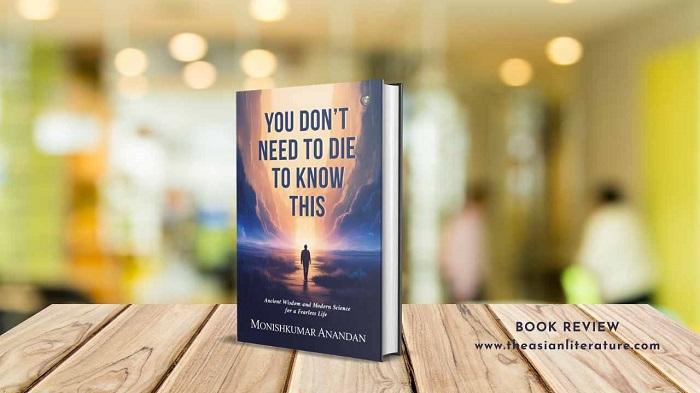
Book Review You Don’t Need to Die to Know This Ancient Wisdom and Modern Science for a Fearless Life
You Don’t Need to Die to Know This: Ancient Wisdom and Modern Science for a Fearless Life by Monishkumar Anandan is a quietly powerful meditation on life, mortality, and consciousness. Rather than treating death as a dark or frightening subject, the book approaches it as a mirror—one that reflects how consciously or unconsciously we are living. In doing so, the author shifts the reader’s focus away from fear of the end and toward awareness of the present moment.
The book You Don’t Need to Die to Know This begins with a deeply personal near-death experience that altered the author’s understanding of existence. This incident is not presented as a dramatic spectacle, but as a moment of profound stillness—an interruption of ordinary life that revealed its fragility and beauty at the same time. From this experience, Anandan embarks on a thoughtful exploration of questions most people avoid: What is death? What remains when the body stops? And how should the awareness of impermanence change the way we live?
One of the most compelling qualities of this book is its inclusive perspective. Anandan does not limit his exploration to a single belief system. Instead, he draws insight from multiple religious traditions—Hinduism, Buddhism, Christianity, Islam, Sikhism, and Taoism—demonstrating that while rituals and doctrines differ, the essence of their teachings remains strikingly similar. Across cultures and centuries, the message is consistent: live with compassion, awareness, and responsibility, because how we live matters far more than what we claim to believe.
Equally significant is the author’s engagement with modern spiritual thinkers and mystics such as Sadhguru, Eckhart Tolle, Osho, Ram Dass, Mooji, and Alan Watts. These voices bring clarity to ancient truths by expressing them in contemporary language. Through their teachings, death is no longer portrayed as an enemy but as a natural and inseparable part of life. The fear of death, the book suggests, is often rooted not in dying itself, but in the sense that we have not truly lived.
The scientific dimension of the book adds depth and credibility to its spiritual reflections. Anandan introduces readers to research on near-death experiences, consciousness, and neuroscience, including studies conducted by doctors and researchers who have observed awareness continuing even when the brain appears inactive. While the book does not claim definitive scientific proof of life after death, it raises meaningful questions about the nature of consciousness and challenges the assumption that the mind is merely a byproduct of the brain.
This balanced approach—neither dismissing science nor undermining spirituality—is one of the book’s strongest achievements. Instead of forcing conclusions, the author invites curiosity. Science and spirituality are presented not as opposing forces, but as complementary paths seeking to understand the same mystery from different directions.
Stylistically, the book is written in a gentle, reflective tone. The language is simple, accessible, and emotionally resonant. Anandan avoids preaching or asserting authority; instead, he writes as a fellow seeker sharing insights from his journey. This makes the book approachable for a wide audience, including those who may be skeptical of spiritual literature. The absence of rigid dogma allows readers to engage with the ideas at their own pace and from their own perspective.
What makes You Don’t Need to Die to Know This especially impactful is its practical relevance. The book consistently returns to one essential point: awareness of death is not meant to paralyze us—it is meant to free us. When we truly accept impermanence, trivial worries lose their grip, relationships gain depth, and ordinary moments become meaningful. The book gently encourages readers to live with presence, gratitude, and emotional honesty, not as spiritual ideals, but as everyday practices.
Emotionally, the book leaves a lasting impression. It softens the reader’s relationship with fear and replaces it with acceptance and curiosity. Death is no longer a distant threat, but a quiet reminder to live consciously. By the end, readers are likely to feel less anxious about what lies ahead and more attentive to the life unfolding right now.
In essence, You Don’t Need to Die to Know This is not a book about dying—it is a book about awakening. It does not promise answers about the afterlife, nor does it attempt to define the unknowable. Instead, it offers something far more valuable: a shift in perspective that encourages a fearless, meaningful, and deeply human way of living.
For readers seeking clarity, inner calm, or a renewed connection with life, this book serves as a gentle companion—one that reminds us that wisdom does not require tragedy, and awakening does not require death. Everything we seek, the author suggests, is already available in this moment—if we are willing to pause, breathe, and truly be present.