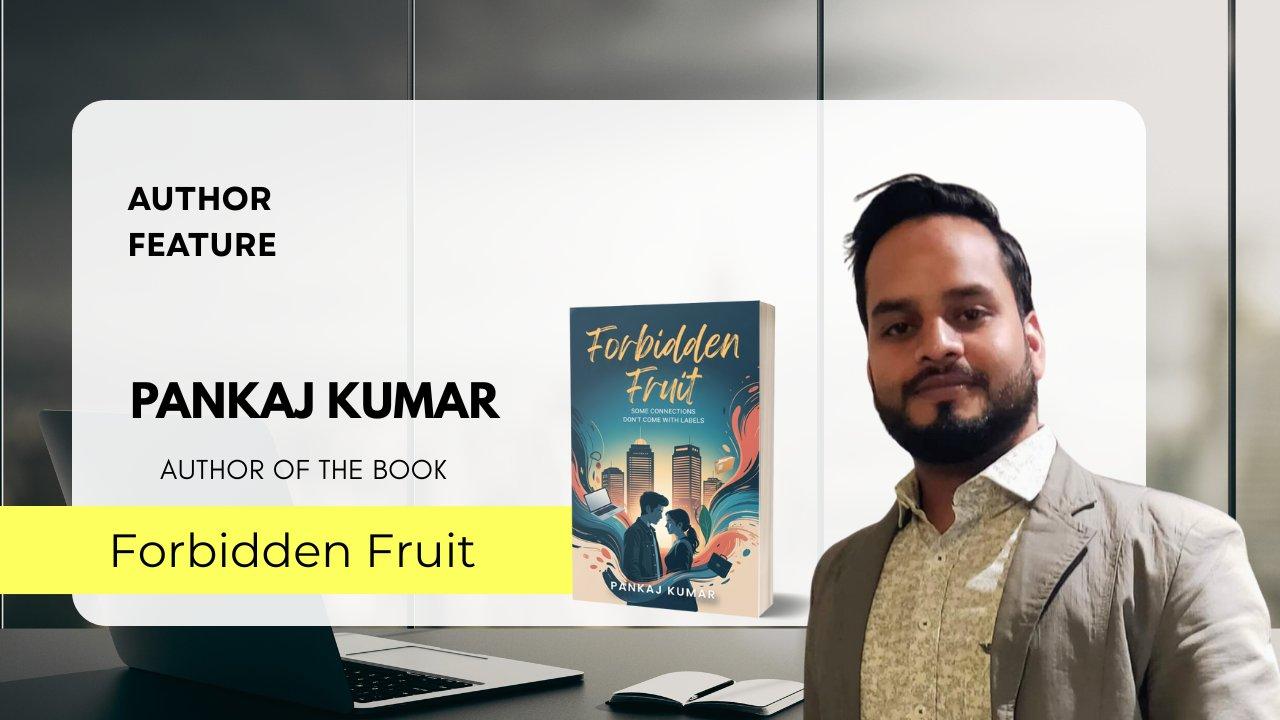
Not every connection needs a name. Some are felt, not defined.
An Author Feature on Pankaj Kumar and His Debut Novel
In today’s fast-moving world of deadlines, office buses, performance reviews, and silent loneliness, relationships are no longer simple. Love does not always arrive with clarity. Sometimes, it comes quietly, without permission, without definition, and without a name. Forbidden Fruit: Some Connections Don’t Come With Labels, written by Pankaj Kumar, captures this exact emotional space with honesty and tenderness.
Set in the corporate landscape of Gurgaon, Forbidden Fruit is not just a love story. It is a reflection of modern adulthood—confused, vulnerable, awkward, and deeply human. It speaks to a generation that is learning to balance ambition with emotion, independence with longing, and logic with the heart.
A Story Rooted in Real Life
Forbidden Fruit unfolds in familiar places—an office bus, cubicles, cafeterias, apartment societies, and ordinary neighbourhoods. These are places most working professionals recognise instantly. Yet within these everyday spaces, different lives are unfolding at the same time. Everyone is carrying their own silent stories, private struggles, and unspoken desires.
The novel explores how relationships grow slowly—sometimes clumsily, sometimes beautifully—without clear rules or labels. It shows how people drift into emotional bonds without fully understanding what they are entering. Is it friendship? Is it attraction? Is it love? Or is it simply a connection that exists because two people see something familiar in each other?
This uncertainty is the emotional core of Forbidden Fruit.
Not a Typical Romance
Although Forbidden Fruit is described as a romantic dramedy, it goes much deeper than surface-level romance. The book is, at heart, a coming-of-age emotional psychology novel disguised as a love story. It explores what happens inside the mind when emotions grow faster than understanding.
The characters are not heroes or villains. They are ordinary people—flawed, confused, sometimes selfish, sometimes kind. They make mistakes. They hesitate. They care too much or too little at the wrong time. And that is exactly what makes them real.
This is not a story of dramatic declarations or perfect love. It is about quiet feelings, missed signals, long waits, and emotions that don’t always get a chance to be spoken aloud.
The Corporate World as an Emotional Space
One of the strongest aspects of Forbidden Fruit is how it uses the corporate environment as more than just a backdrop. Offices are not shown only as places of work, but as emotional spaces where people spend most of their waking hours.
The office bus becomes a moving world of gossip, tension, attraction, irritation, and silent observation. The workplace becomes a stage where professionalism hides personal chaos. The lunch breaks, meetings, and casual conversations reveal how people perform roles while quietly managing their inner lives.
Pankaj Kumar captures this world with sharp observation and gentle humour. Anyone who has worked in a corporate setup will see themselves—or someone they know—in these pages.
Themes That Feel Personal
Forbidden Fruit touches many themes that feel deeply personal to modern readers:
- Unspoken love and emotional confusion
- Power dynamics in relationships
- Boundaries that are unclear or crossed
- Loneliness despite being surrounded by people
- The struggle between responsibility and desire
- Growing up emotionally while managing adult life
The subtitle, Some Connections Don’t Come With Labels, perfectly sums up the book’s soul. Not every relationship fits into a defined box. Some connections exist in grey areas, and trying to force a label on them can destroy their fragile beauty.
A Tender Yet Honest Tone
The writing style of Forbidden Fruit is simple, conversational, and deeply relatable. Pankaj Kumar does not rely on heavy language or dramatic exaggeration. Instead, he lets situations speak for themselves.
There is humour in everyday awkwardness. There is sadness in missed timing. There is tenderness in small gestures. The emotions feel lived-in, not manufactured.
Readers may find themselves smiling at familiar moments, feeling uncomfortable at emotional truths, or pausing to reflect on their own past connections.
About the Author: Pankaj Kumar
Pankaj Kumar is a working professional with over fifteen years of experience in the corporate world. At 37, he balances multiple roles in life—husband, father, professional, and now, author.
His strength as a writer comes from observation. Having spent years in office environments, travelling in company buses, attending meetings, and watching people interact daily, he understands the silent emotional undercurrents that often go unnoticed.
For Pankaj, writing is not about grand imagination. It is about capturing small truths—the moments people ignore but quietly remember. His characters are shaped by reality, not fantasy. They behave like real people because they are inspired by real situations.
Forbidden Fruit is his first book, born from years of observing human behaviour, emotional hesitation, and the complicated nature of modern relationships.
Why Forbidden Fruit Matters
In a time when love is often rushed, defined quickly, and displayed loudly, Forbidden Fruit reminds readers that some emotions need time. Some connections are not meant to be rushed or explained. They exist because they feel real, even if they are confusing.
The book speaks especially to:
- Young professionals navigating emotional and career pressures
- Readers who have experienced one-sided or undefined relationships
- Anyone who has waited too long or loved quietly
- Those who have learned to rebuild themselves after emotional loss
It is a book for people who understand that not all love stories have a clear beginning or a neat ending.
A Journey of Growth and Healing
At its heart, Forbidden Fruit is also a story of emotional growth. It shows how people change through experiences—how innocence fades, how understanding deepens, and how courage slowly returns after disappointment.
The journey is not always comfortable, but it is honest. And that honesty is what makes the book powerful.
Final Thoughts
Forbidden Fruit is not a book that shouts. It speaks softly, like a quiet conversation on a late bus ride or an unspoken thought during a workday. It trusts readers to feel rather than be told what to feel.
Pankaj Kumar’s debut is a sincere, thoughtful exploration of modern love and emotional uncertainty. It does not offer easy answers, because real life rarely does. Instead, it offers recognition—and sometimes, that is enough.
For anyone who has ever cared too deeply, waited too long, or loved without a label, Forbidden Fruit will feel uncomfortably familiar—and deeply comforting at the same time.
Connect with the Author
📧 Email: storiesbypankaj@gmail.com
📷 Instagram: @storiesbypankaj