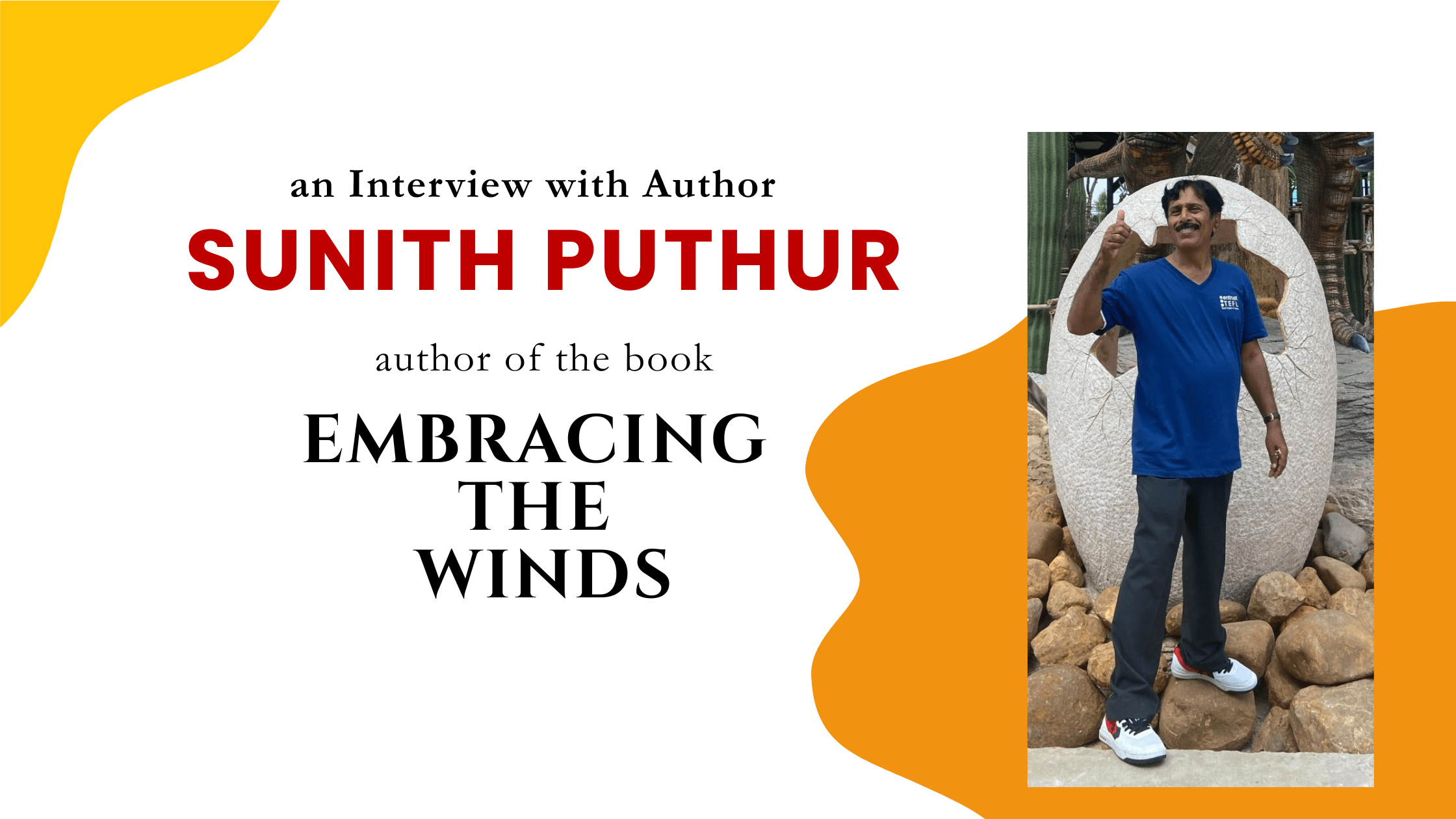
Sunith Puthur
About The Author
Sunith Puthur Born in Ramasseri, Palakkad, the author’s imagination was shaped by Kerala’s hills, rivers, and forests, fostering a lifelong love for storytelling. Literary heritage runs deep in the family, notably through an ancestor who translated the Sreemad Bhagavatham into Malayalam in 1872. Writing began early, with the author’s first short story penned in ninth grade. Among the notable works is a book on the river Nila, with a foreword by Dr. E. Sreedharan. A career that began in 1970s Bombay enriched the author’s understanding of society. The historical saga Embracing the Winds traces personal destinies shaped by sweeping historical forces.
Interview with Sunith Puthur
1. What first compelled you to write Embracing the Winds? Was it a single image, memory, or an emotional impulse?
Author: It was the impending impulse to reinterpret the incidents which pushed a family’s fate on a particular direction.
2. The novel’s pace feels deliberate — almost meditative. How did you decide on the rhythm and tone of your prose?
Author: The meditative pace of the novel is a reflection of the protagonist’s own stream of thought- his reflections, hesitations, and insights.
3. Many chapters read like independent stories that flow into each other. How did you approach structuring the book?
Author: The structure of chapters reflects stages in the mental journey of the protagonist synchronising with his actual journey to Basra.
4. Your language feels deeply rooted in Malayalam cadence even though you write in English. How do you maintain that balance?
Author: The contemplative sweep of the sentences in my novel echoes the natural cadence of Malayalam. Immersed in the changing seasons and the pulse of the surrounding nature, that rhythm spontaneously infused into my English prose.
5. What was the most challenging scene or emotion to translate into words?
Author: The most challenging moment was capturing the surge of emotions that rose within the mind of the protagonist when he spotted an eagle hovering above the ship, far from the shoreline.
6. You often use sensory detail — sound, scent, and texture — rather than exposition. Is that a conscious stylistic choice?
Author: I trust the senses more than explanations. They carry the truth of a moment more vividly than exposition ever can. Real experiences loss its sheen by choosing exposition.
7. How do you see the relationship between realism and poetry in your storytelling?
Author: Realism gets transformed into poetry when it reveals the beauty inherent in ordinary life. Realism is not anti-thetical to poetry and it acquires appeal when becomes universal.
8. Several passages feel cinematic. Have you ever imagined Embracing the Winds being adapted into a film or series?
Author: I never entertained any idea to adapt my novel into a cinema. I have framed each scene as a separate chapter, yet an invisible thread weaves the entire work intact.
9. What does the editing process look like for you? Do you rewrite extensively or rely on first intuition?
Author: Editing process is very critical for me. It takes more time than the actual composition of the work. It takes place with a lot of additions and changes in the narrative.
10. If you could describe your writing philosophy in one sentence, what would it be?
Author: My writing philosophy is that the writer should have something to revisit and reinterpret events and relationships in family and society.
Book Title: Embracing The Winds
Author: Sunith Puthur
Publisher: Evincepub Publishing