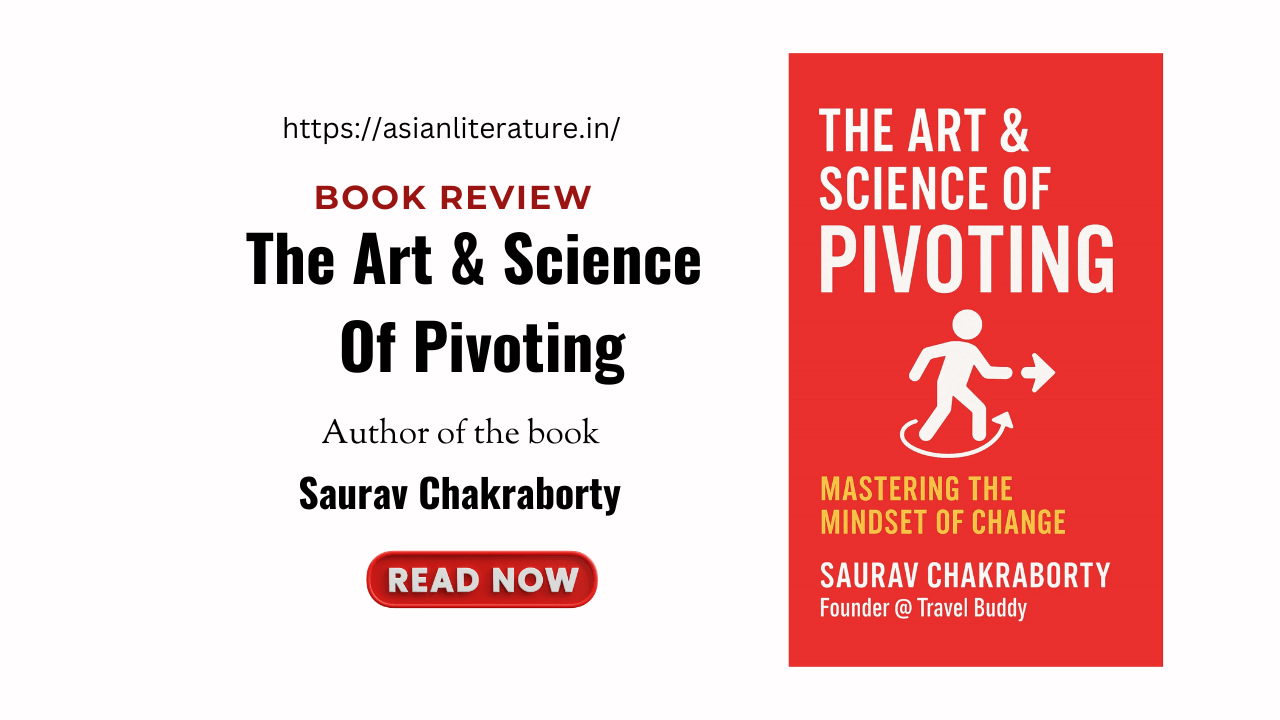
The Art & Science Of Pivoting
In an age where reinvention is no longer an exception but a necessity, The Art & Science of Pivoting arrives as both a guide and a gentle mirror. Rather than treating “pivoting” as a purely strategic or corporate maneuver, the book expands the idea into something far more human — a process of inner listening, conscious unlearning, and courageous redirection.
What distinguishes this work is its refusal to reduce change into formulas or productivity hacks. The author does not approach pivoting as a quick fix to failure or stagnation; instead, pivoting is presented as a dialogue between one’s inner life and outer circumstances. This makes the book feel less like a business manual and more like a philosophical companion for moments of uncertainty.
The writing moves fluidly between reflection and application. The “science” of pivoting — patterns of behavior, decision-making frameworks, and external signals — is balanced carefully with the “art” — intuition, emotional honesty, and personal meaning. This balance prevents the book from slipping into either cold rationalism or vague motivational rhetoric. Instead, it occupies a rare middle ground where clarity and compassion coexist.
One of the book’s greatest strengths is its respect for ambiguity. The author does not promise certainty or guarantee success. In fact, the narrative repeatedly reminds the reader that pivoting often feels uncomfortable, disorienting, and lonely before it becomes liberating. This honesty gives the book credibility. It acknowledges grief for the life not chosen, the identity left behind, and the familiar comfort of the old path — and treats those emotions not as obstacles but as integral parts of transformation.
Stylistically, the prose is calm, reflective, and accessible. There is a quiet confidence in the writing that never feels preachy or prescriptive. The author does not speak at the reader, but with them — as a fellow traveler navigating complexity. This tone makes the book especially resonant for readers who are already thoughtful, introspective, and perhaps quietly struggling with questions of direction.
What makes The Art & Science of Pivoting particularly relevant today is its rejection of hustle culture’s obsession with constant growth. Instead, it proposes alignment over acceleration, depth over speed, and authenticity over optimization. Pivoting, here, is not about chasing trends, but about returning to one’s evolving truth.
Ultimately, this book is less about changing careers or strategies and more about changing one’s relationship with change itself. It invites the reader to see uncertainty not as a threat, but as a threshold — a space where new meaning can emerge.
For anyone standing at a crossroads — personal, professional, or spiritual — The Art & Science of Pivoting offers not a map, but a lantern. It does not tell you where to go, but helps you see more clearly as you walk.
Title: The Art & Science Of Pivoting
Author: Saurav Chakraborty
Publisher: Evincepub Publishing